

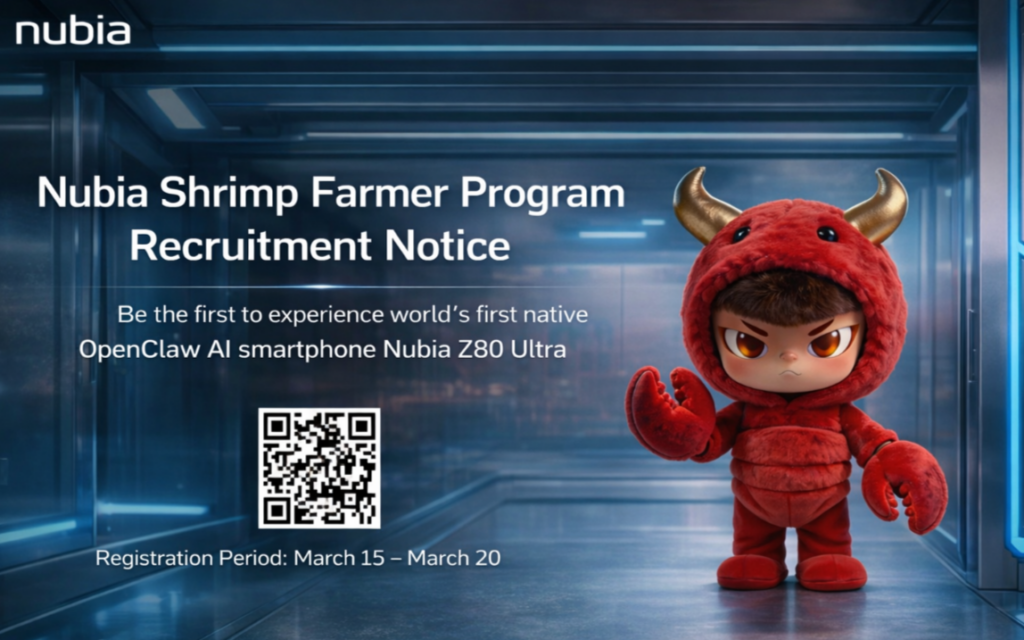
Nubia has announced a new internal testing initiative called the “Nubia Shrimp Farmer Program,” aimed at recruiting beta testers for OpenClaw AI integration on the Nubia Z80 Ultra. Selected users will be able to test the system before the public rollout, helping Nubia refine the AI experience through real-world usage.
According to the company, the Nubia Z80 Ultra will be the world’s first smartphone to natively integrate OpenClaw. Unlike most smartphones, where AI runs as a separate app or cloud service, Nubia is embedding OpenClaw directly into the phone’s operating system. This allows the AI to interact with apps, settings, and system functions more naturally.
Ni Fei, President of the ZTE Terminal Business Unit and President of Nubia Technology, described the device as a “Gateway-type AI phone.” It supports ClawBot scenario-based applications and access to a broader Skills ecosystem, allowing the AI to automate tasks and work across multiple services. This also means AI features can run faster and handle tasks more directly within the operating system.
The Nubia Z80 Ultra, launched on October 22, features the Snapdragon 8 Ultra (5th generation) processor and a 50MP 35mm “Master Eye” main camera with a 1/1.3-inch sensor and DCG dual conversion gain HDR technology. Nubia also offers an optional photography kit for enhanced camera capabilities. The phone starts at 4,999 yuan (around $730).
Why This Matters for Users
OpenClaw could make Nubia phones feel more intelligent and proactive. Because the AI is built into the system, it can automate tasks, manage apps, and respond faster than typical AI assistants. For users, this could translate into smoother voice commands, smarter automation, and deeper AI integration across everyday phone activities rather than relying on separate AI apps.
What is OpenClaw AI?
OpenClaw is an open-source AI agent designed to do more than just answer questions. It can connect with apps, files, and online services to automate real tasks such as browsing the web, managing messages, scheduling actions, or completing multi-step workflows. In simple terms, it turns AI from a basic chatbot into a task-executing digital assistant that can actively perform actions across different apps and services.
Read More:
(via)


