

Researchers at China’s Tsinghua University’s Shenzhen International Graduate School have developed a next-generation tactile sensor called SuperTac. The project involved collaboration with multiple domestic and international institutions and was inspired by the unique visual structure of pigeon eyes. The research aims to solve one of robotics’ biggest challenges: enabling robots to sense touch with human-like precision and understanding.
The study was published on January 15 in Nature Sensors under the title “Biomimetic Multimodal Tactile Sensing Enables Human-like Robotic Perception.”
Why Robotic Touch Is a Big Deal
As embodied intelligence advances, robots are moving beyond controlled factory floors into human-centered environments. This shift demands high-resolution tactile sensing, multimodal perception, and better interpretation of physical contact. Current tactile sensors still struggle with limited resolution and weak data fusion, making touch one of the main bottlenecks in robotic perception.
What Makes SuperTac Special
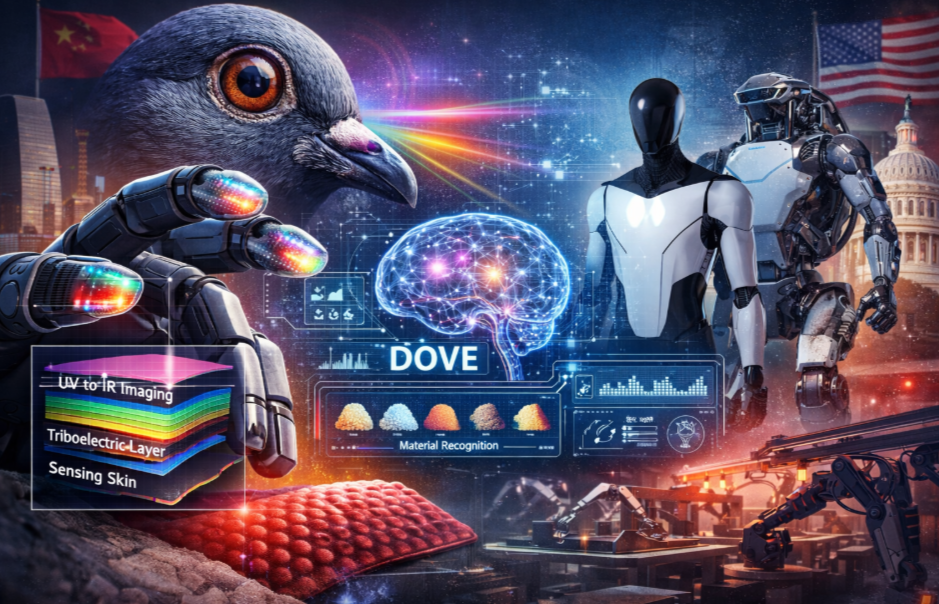
SuperTac is a multimodal, high-resolution tactile sensor that combines multispectral imaging (from ultraviolet to mid-infrared) with triboelectric sensing signals. Its ultra-thin, multi-layer sensing skin allows micrometer-level resolution and can detect force, contact position, temperature, proximity, and vibration. The system can identify material type, texture, slippage, collision, and even color with over 94% accuracy.
DOVE: Teaching Robots to Understand Touch
To process this complex tactile data, the team developed DOVE, an 850-million-parameter tactile language model. DOVE enables robots to interpret touch information in a more human-like way, significantly improving environmental understanding and manipulation accuracy.
China vs the US: The Humanoid AI Race
The SuperTac breakthrough also reflects the broader China–US humanoid AI competition. China is currently ahead in robot hardware, sensors, and large-scale deployment, supported by strong manufacturing and fast research-to-product cycles. The US, meanwhile, leads in AI software, foundation models, and autonomous intelligence, driven by companies like Tesla, Figure AI, and Boston Dynamics. In the short term, China may dominate physical humanoid deployment, while long-term leadership will depend on who best combines advanced hardware with powerful AI brains.
What to Expect?
SuperTac has already been integrated into robotic dexterous hands, enabling real-time tactile feedback. Looking ahead, this technology could transform manufacturing, medical robotics, and service robots, bringing the industry closer to robots that can truly see, think, and feel like humans.
Read More:
(via)


