

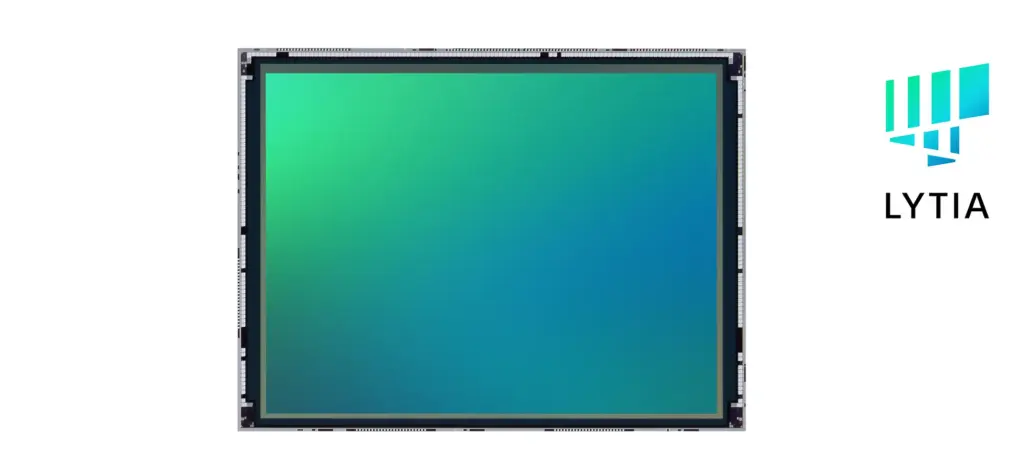
Sony has officially entered the 200MP mobile camera sensor race with the launch of the LYTIA 901, a large-format sensor designed to prioritize in-sensor zoom, AI remosaicing, and superior dynamic range.
Samsung, which already dominates this segment with its ISOCELL HP2, HP5, and HP9 sensors, continues to focus on flexible multi-camera setups and ultra-compact designs. Here’s a detailed comparison between Sony’s and Samsung’s latest 200MP image sensors.
1. Sensor Size and Pixel Architecture
Sony’s LYTIA 901 uses a 1/1.12-inch optical format with a 14.287mm diagonal, making it the largest sensor in the 200MP class. It features a pixel size of 0.7μm and uses a Quad-Quad Bayer Coding (QQBC) filter arrangement. This setup boosts light-gathering performance and provides improved dynamic range. Sony aims to deliver flagship-level performance with a single main sensor instead of relying on additional telephoto modules.
Samsung has released multiple 200MP sensors with varying sizes. The ISOCELL HP2, found in the Galaxy S25 Ultra, uses a 1/1.3-inch format and 0.6μm pixels. The HP5, used in the Vivo Y500 Pro, measures 1/1.56 inches with 0.5μm pixels.
The HP9, optimized for telephoto cameras in models like the Vivo X100 Ultra and Xiaomi 15 Ultra, uses a 1/1.4-inch format with 0.56μm pixels. Samsung’s sensors prioritize compactness and modularity, supporting thinner device designs and hybrid zoom setups.
2. Pixel Binning and Zoom Technologies
Sony’s LYTIA 901 features a QQBC structure that clusters 16 adjacent pixels of the same color. It captures 12.5MP images in low-light scenarios and switches to full-resolution imaging through a remosaicing process when zooming. The sensor also supports 2×2 binning for 50MP output.
Sony has embedded AI-driven remosaicing directly into the sensor. This allows high-quality 4x in-sensor zoom and smooth video capture without offloading processing to the ISP.
Samsung relies on its Tetra²pixel binning. The sensors combine pixels to operate at 50MP (1.0μm) or 12.5MP (2.0μm), depending on lighting. The ISOCELL HP5 and HP9 also support 2x or 4x in-sensor zoom.
When paired with a 3x optical telephoto lens, these sensors can achieve up to 12x hybrid zoom. Samsung’s design works well in multi-camera arrays and supports various zoom configurations depending on the module.
3. HDR and Color Reproduction
Sony integrates multiple layers of HDR processing. It supports DCG-HDR and Fine12bit ADC to enhance tonal depth and dynamic range even at 4x zoom. Furthermore, Sony’s Hybrid Frame HDR (HF-HDR) blends short-exposure and high-gain data, enabling performance over 100dB in additive mode, useful for capturing scenes with both intense highlights and deep shadows.
Samsung’s HDR stack features Smart-ISO Pro, staggered HDR, and dual-slope gain (DSG), particularly in the HP2 and HP9 sensors. The HP9 even achieves 14-bit color depth, delivering trillions of color combinations. However, Sony’s in-sensor AI processing arguably allows for more accurate remosaicing and real-time tone mapping, giving it an edge in scenarios like document scanning or pattern recognition.
4. Frame Rates and Video Performance
Sony’s LYTIA 901 can shoot at 10fps in full 200MP RAW, 30fps at 50MP binned, and 60fps at 12.5MP. Video recording supports 8K at 30fps and 4K at 120fps, with AI-accelerated remosaicing allowing 4x zoom during 4K video. This makes it ideal for scenarios where a single sensor must handle zoom, wide-angle, and video tasks without switching modules.
Samsung matches or exceeds this in some areas. The HP2 supports 15fps at 200MP, and the HP5 and HP9 offer up to 480fps at Full HD, 120fps at 4K, and 30fps at 8K. Samsung sensors also support up to 90fps at 12.5MP (HP5/HP9), giving them an advantage in super-slow-motion video recording.
5. Use Cases and Market Positioning
Sony positions the LYTIA 901 for premium flagships that aim to simplify camera hardware. Its focus on in-sensor AI processing, remosaicing, and large-format performance suits devices like the Oppo Find X9 Ultra and Vivo X300 Ultra. The sensor reduces the need for multiple rear cameras while maintaining competitive zoom and video features.
Samsung’s 200MP lineup covers a wider range of use cases. The HP2 targets high-end primary cameras like the Galaxy S25 Ultra. The HP5 is designed for balanced mid-high range devices, while the HP9 powers periscope and telephoto modules in multi-camera flagships. Samsung emphasizes flexibility, allowing OEMs to customize zoom setups based on device thickness and budget.
For more daily updates, please visit our News Section.
Stay ahead in tech! Join our Telegram community and sign up for our daily newsletter of top stories! 💡


