

While some rivals are engaged in a game of one-upmanship over how many touchscreens they can fit into a cabin while quietly downgrading the material quality and number of features, common sense continues to prevail at Hyundai.
The necessary mod cons are all present. There’s a curved array of two 12.3in screens – a driver display and central touchscreen – with a head-up display on higher trims, but it’s complemented by a selection of physical controls for infotainment shortcuts (including a pair of customisable buttons), climate controls and vehicle functions (auto hold, drive mode). All of that means you need little familiarisation to operate the Santa Fe.
None of this comes at the expense of material richness or standard features. Even the entry-level Premium has particularly comfortable and widely adjustable seats with heating and memory functions, as well as a wireless phone charger and enough USB ports to power a small data centre. Most of the stuff that looks like leather, wood or metal actually isn’t, but that would be too much to ask in this price class. More to the point, it’s all convincing enough.
Neither can the Santa Fe be accused of style over substance, because this is a brilliantly well-considered cabin. The clever MPVs of old may be dead, but their spirit lives on in cars such as this. There are two gloveboxes with a shelf between them, as well as storage space under the centre console and room for two phones. Rear passengers aren’t forgotten: they get an extra drawer and the armrest cubby can be opened from both the front seats and the back.
The style arguably results in substance, because the Santa Fe’s squared-off proportions and straight sides mean that very little space is wasted. It goes without saying that second-row passengers aren’t short of space to stretch out, but the third row isn’t compromised on head room either. Those occupants get their own cupholders, charging ports and an air vent with fan control.
Getting in and out isn’t too onerous, either, because the second row slides, mostly manually but with some electric assistance. There are multiple buttons and levers that do the same thing, so you never have to look for the right one.
We would stick with the Premium, because the upper-level trims don’t feel like a massive upgrade, either in terms of materials or features. The second-row captain’s chairs aren’t quite as adjustable as you might hope.
Multimedia
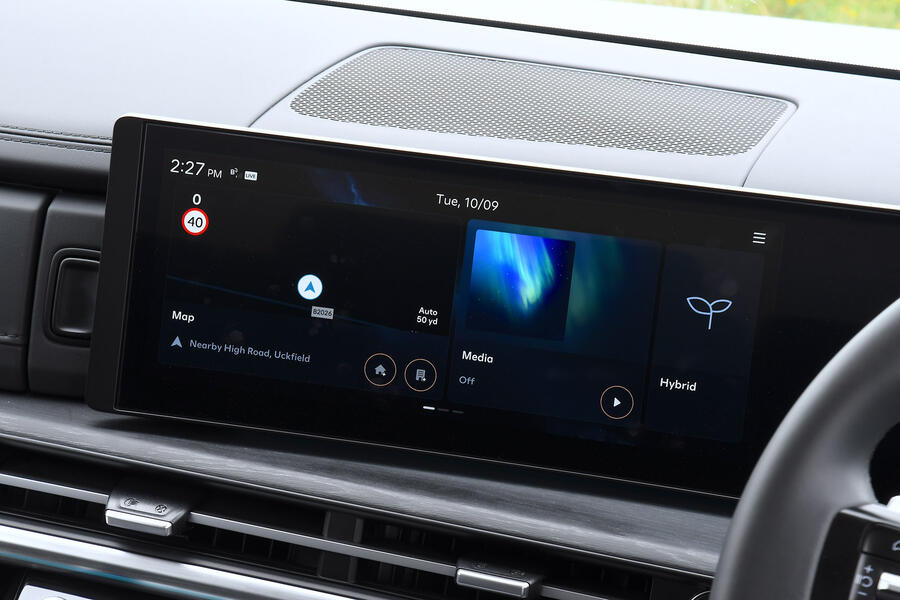
The infotainment in the current generation of Hyundais is carefully considered to simply give you what you need, without any extraneous gimmicks. What’s there works well too. The outgoing generation of Hyundai systems could be a bit laggy and was showing its age in the graphical department, but those issues have been solved now. The new interface looks attractive and responds quickly to prods and swipes, and there’s always the physical shortcut buttons to help you get to where you need to be.
Apple CarPlay and Android Auto can finally be connected wirelessly, and proved reasonably stable and reliable during our test. Hyundai’s built-in navigation system is excellent, with clear directions and accurate traffic updates. It also has one particular feature we like a lot: as well as the fastest, shortest and most economical routes, you can tell the system to favour motorways.
The standard audio system in our Premium car was all right, although we expect the Bose hi-fi on higher trims to represent a decent upgrade.


