

DS has revealed the new No7 as the replacement for its best-selling 7 SUV, the French premium brand’s first bespoke car.
Taking its lead from the design of the new DS No8 flagship, the No7 will offer a choice of hybrid and electric powertrains when it launches later this year – as do the Peugeot 5008, Citroën C5 Aircross, Jeep Compass and Vauxhall Grandland with which it shares a platform.
Slotting between the heavily updated No4 hatchback and No8 crossover, the No7 is DS’s entrant in the crucial mid-sized SUV market, in which premium contenders include the hugely popular Audi Q3 and BMW X1.
It’s the most important model in the new DS line-up, taking over from a model that was consistently its strongest seller – and CEO Xavier Peugeot has told Autocar that its launch will be pivotal in the brand’s plan to dramatically increase its market share and its EV sales mix.
“The current DS 7 represented up to 50% of our sales,” he said. “That’s a blockbuster for which we are preparing the launch of a successor – in a quite different context, with more weight of electric sales, and so this is really an important moment and product launch for us.”
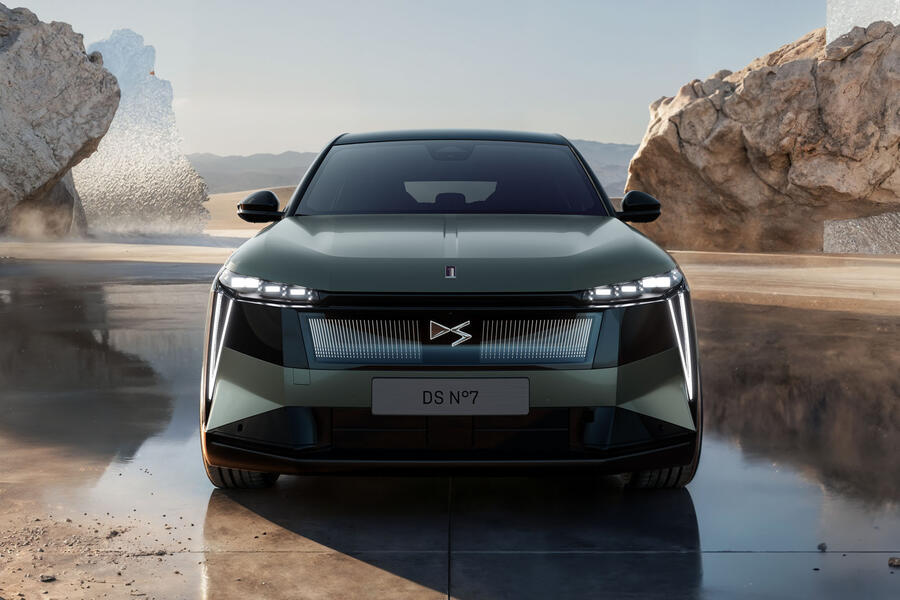
The No7 is a complete departure from its predecessor both inside and out – and, at 4.66m long, slightly larger, with five centimetres more metal between the wheels to the benefit of interior space.
It’s more conventionally SUV-shaped than the No8, which heralded a new era of DS design, but retains the defining cues, including a distinctive V-shaped front light signature, the prominent illuminated grille and the options of two-tone paint and large 21in wheels.
The electric version is equipped with the same chunky 97.2kWh battery that endows the No8 with a class-leading range of 466 miles – but, because it has a more traditionally upright silhouette than its larger sibling, it tops out at at 460 in single-motor Long Range form.
That figure is still comfortably one of the longest ranges available in this segment – a feat achieved by what DS refers to as “exceptionally careful aerodynamics”. It claims a drag coefficient of just 0.26, which it says means the No7 can travel more than 280 miles even at motorway speeds.
There’s also a four-wheel-drive version, which adds a motor on the rear axle to boost power from 242bhp to 370bhp and returns a range of 422 miles.
Meanwhile, a cheaper variant equipped with a 73.7kWh battery and a 228bhp front motor offers 337 miles per charge.


