1. Design and Display
Build and Feel
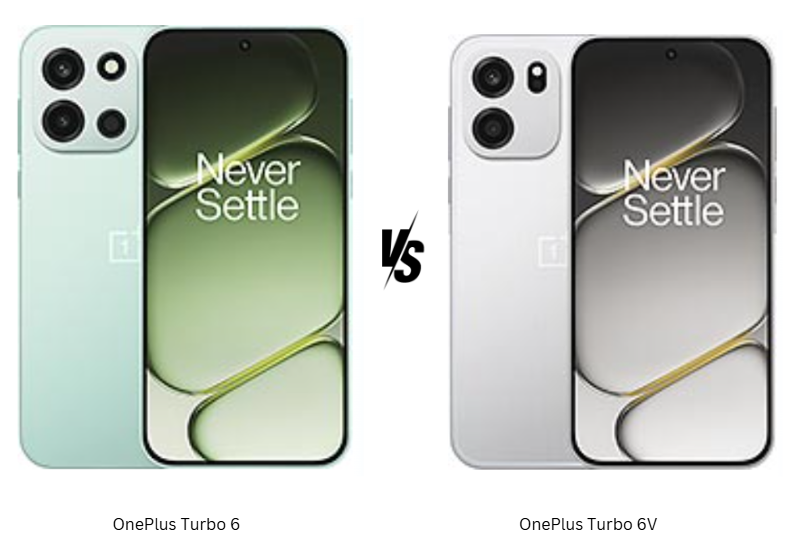
Both phones share the same design philosophy, durability focus, and IP68/IP69K protection, making them equally tough for daily use and rough conditions. The overall feel is solid and reassuring on both models, with no compromise in build quality on the cheaper Turbo 6V. However, the Turbo 6 feels more premium in intent, clearly positioned as the higher-tier option. The Turbo 6V mirrors almost everything physically, making it impressive for its price, but branding and positioning still give the Turbo 6 a more flagship-oriented appeal.
Display Quality
The Turbo 6 clearly leads with its 165Hz AMOLED panel and HDR Vivid support, delivering smoother animations and better HDR video playback. The Turbo 6V’s 144Hz AMOLED display still looks sharp and vibrant, but lacks the extra smoothness and HDR depth. For everyday scrolling, the difference is subtle, yet gamers and content consumers will notice the Turbo 6 feels more fluid and immersive.
Verdict
Turbo 6 suits users who want the best display experience, while Turbo 6V offers excellent visuals at a lower cost.
2. Specifications
Performance
The Turbo 6’s Snapdragon 8s Gen 4 delivers flagship-level performance, faster storage speeds, and better long-term reliability under heavy workloads. It handles gaming, multitasking, and demanding apps with ease. The Turbo 6V’s Snapdragon 7s Gen 4 is tuned for efficiency, performing smoothly for daily tasks and casual gaming, but it does not match the raw power or future-proofing of the Turbo 6. The difference becomes noticeable during extended gaming or intensive multitasking.
Battery and Charging
Both phones use the same large silicon-carbon battery and identical fast-charging support. Battery life is excellent on both, easily lasting a full day or more. The Turbo 6V may feel slightly more efficient due to its mid-range chipset, but charging speeds and convenience remain identical.
Verdict
Turbo 6 is better for power users, while Turbo 6V is ideal for balanced everyday performance with excellent battery life.
3. Camera
Main and Secondary Lenses
Both phones feature similar 50MP main cameras with OIS, delivering sharp and reliable photos in good lighting. The Turbo 6 benefits from stronger image processing, resulting in better HDR consistency and smoother high-frame-rate video recording. The Turbo 6V still performs well for casual photography but feels more tuned for reliability than creative flexibility.
Selfie Camera
The selfie cameras are nearly identical, offering consistent results for video calls and social media. Differences are minimal and unlikely to influence buying decisions.
Verdict
Turbo 6 is better for video-heavy users, while Turbo 6V comfortably handles everyday photography needs.
4. Pricing
OnePlus Turbo 6 is priced at around $350, offering flagship-level performance, faster storage, and a more advanced display. It targets users who want long-term performance and smoother visuals.
OnePlus Turbo 6V comes in at around $300, retaining the same durability, battery, and camera hardware while cutting costs on performance and display features. It delivers strong value without obvious compromises in daily use.
Verdict
Turbo 6 justifies the extra cost for performance-focused buyers, while Turbo 6V is the smarter value pick for most users.
Disclaimer:
Prices are approximate and may vary based on country, region, and applicable taxes.
5. Conclusion
The Turbo 6 stands out with its high-end chipset, 165Hz HDR display, and faster storage, making it ideal for gaming and heavy multitasking. The Turbo 6V focuses on efficiency, offering the same battery size, durability, and core experience at a lower price. Both phones deliver modern connectivity, strong speakers, and clean software.
Verdict
Choose the OnePlus Turbo 6 for maximum performance and display smoothness. Choose OnePlus Turbo 6V for better value, excellent battery life, and a reliable, premium-feeling smartphone at a lower price.
Read More: