

The entry-grade Vivaro Life model, called the Combi, comes as a nine-seater, with three rows of three seats each – the middle one in the front effectively being the usual smaller ‘jump seat’ style one. This is the car at its most basic and simple. The middle row of seats tilts and slides to grant better access to the third row, but otherwise there are no versatility tricks to unearth here. The Combi really is the ‘Supermarket Basics’ minibus version (and it comes with a price to match; £35,400 at the time of writing, including the UK government’s Electric Car Grant).
Above it sit the Design and Ultimate model grades. The Design loses the central jump seat in row one, making room for passengers to step through between the first and second rows – but keeps the cloth upholstery, and doesn’t add any flexibility or configurability for the seats further rear.
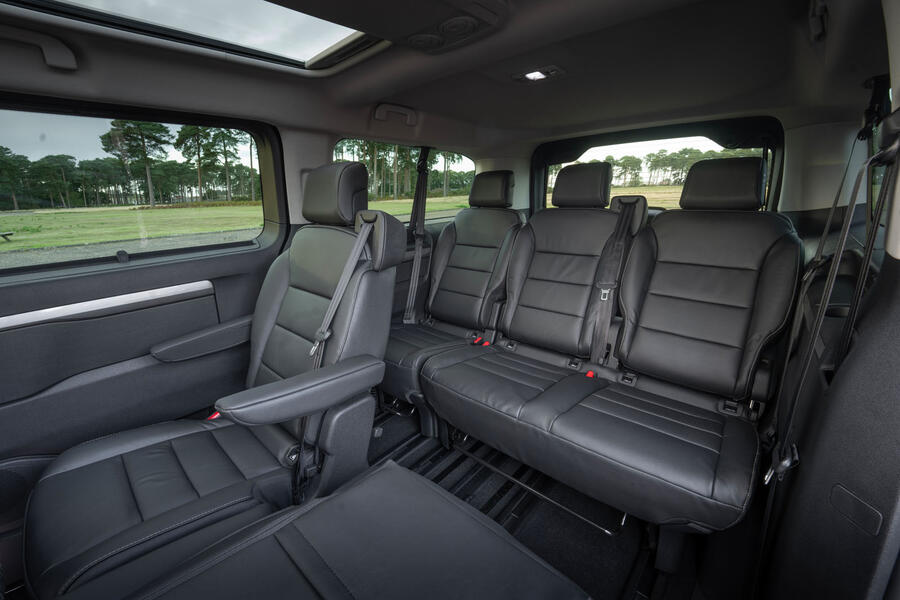
With the Ultimate, however, the Vivaro Life’s cabin layout starts to get quite interesting, as our test car proved. Like the Design version, the car comes as an eight-seater as standard, with two rows of three seats behind the front two-. The front chairs have armrests, heaters and massagers as standard – and ‘Claudia’ black leather upholstery is standard throughout.
If you prefer, however, you can choose either a seven- or six-seat cabin configuration instead; which substitute either one or both of the three-seater rows for a pair of individual chairs, each with its own armrests inboard and out-.
These fix to what Vauxhall calls ‘Drop and Go’ mounting rails, just as the standard seats do; and those rails enable all of the car’s seats aft of the front row to slide – or to be removed and returned, as necessary. The individual chairs come with a sliding storage console that fits between them, with fold-out picnic tables to each side, cupholders in between, and a covered storage cubby to the rear. It, too, can be removed.
All of which means, if you have a top of the range Vivaro Life, you really can configure the cabin exactly as you like. Take all of the back seats out and you’re left with a huge cargo-cum-sleeping/living area. Take the middle row out and you have what feels like an oversized taxi, complete with powered sliding side doors and either executive seating for two in the rear, or a normal three-seat bench. Take the third row out and you have something akin to a four- or five-seater ‘crew cab’ van.
You probably wouldn’t mess about and experiment with seating arrangements for fun, because the seats themselves are quite heavy and cumbersome (the two-seater bench units particularly); and they can be a little tricky to slot back into the rails from which they were removed. But, however demanding the process to go through is, the end result is nonetheless impressive: the ability to tailor your Vivaro’s massive cabin layout to perfectly suit your particular passenger/cargo needs – to ideally provide holiday transport, or for major flatpack furniture shopping runs. The potential for flexibility is every bit as vast as the available space.
You can also pay for a separately-opening rear window for the car as an option, if you find the reality of dealing with the slightly awkward, wide-swinging, full-height bootlid a chore on a daily basis (which, trust us, you will). Whatever the carrying need, the Vivaro Life can likely provide for it.


